Anki vs Quizlet: What Is the Difference for Students Today? – Students today face a big choice. They need tools that help them remember facts. Anki and Quizlet both use flashcards. Yet they work in very different ways. This guide shows the key differences. It uses recent comparisons from 2025 and 2026.
First, let’s look at the basics. Then we will compare features. Finally, you can pick the right one for your needs.
If you need the basics first, read our complete guide to Anki and Quizlet.
What Is Anki?
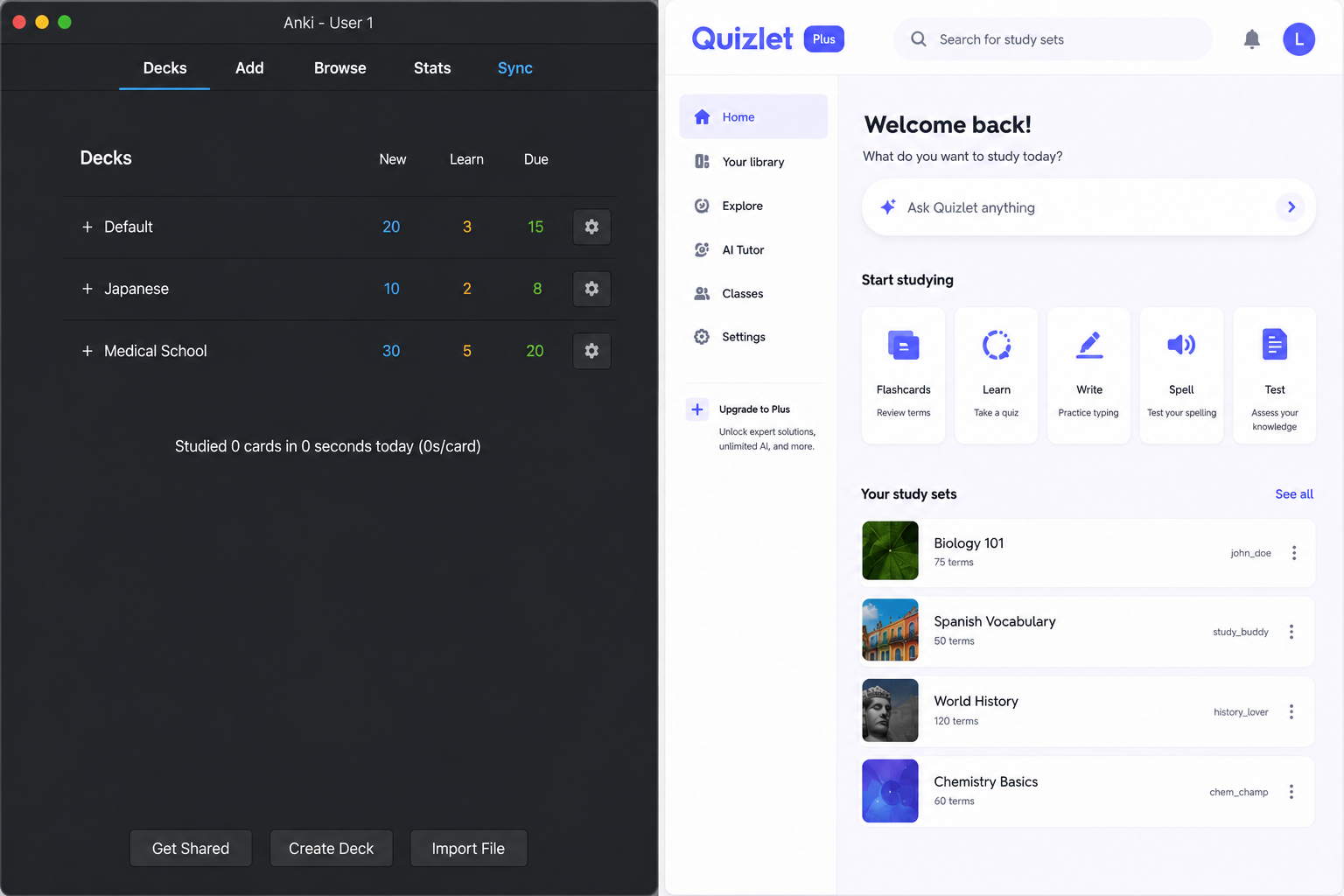
Anki is a free flashcard app. It focuses on long-term memory. It uses a strong spaced repetition system. This system shows hard cards more often. Easy cards appear less often.
Anki started for language learning. Now many medical students use it. The app runs free on desktop and Android. The iOS version costs about $25 one time. You can add images, audio, and special card types. Community decks exist on AnkiWeb. Some decks help with big exams.
However, Anki has a steep learning curve. Setup takes time. The interface looks older. Still, the science behind it is strong.
What Is Quizlet?
Quizlet is a popular study site and app. It offers millions of ready-made sets. Students share cards for almost every subject. The design feels modern and simple.
You can study with flashcards, games, tests, and match modes. Learn mode adapts a bit to your answers. Group features let classes study together.
The free version has limits and ads. Full features need Quizlet Plus. That plan costs around $36 per year. It adds offline access, no ads, and better tools. Quizlet works well for quick review.
Side-by-Side Feature Comparison
Here is a clear table of the main differences:
| Feature | Anki | Quizlet |
|---|---|---|
| Spaced Repetition | Advanced (FSRS or SM-2 algorithm) | Basic (mainly in paid Learn mode) |
| Price | Free (desktop/Android); $25 one-time iOS | Free with limits; ~$36/year for Plus |
| Ease of Use | Steep learning curve | Very easy, quick start |
| Pre-made Content | Good community decks (strong in medicine) | Huge library (hundreds of millions of sets) |
| Customization | Very high (add-ons, templates, code) | Limited |
| Offline Access | Always available | Paid plan only |
| Mobile Apps | Free Android; paid iOS | Free iOS and Android |
| Collaboration | Limited | Strong (Live, classes, shared sets) |
| Best For | Long-term retention over months/years | Short-term study and quick tests |
This table shows the core split. Anki wins on memory science. Quizlet wins on speed and sharing.
For a deeper feature-by-feature comparison, see our Anki vs Quizlet comparison.
Spaced Repetition: The Biggest Difference
Spaced repetition is key. It fights the forgetting curve. You review facts just before you forget them.
Anki does this very well. Its algorithm tracks how well you know each card. Hard cards return soon. Easy ones wait longer. Newer versions use FSRS. This system cuts review time while keeping high retention. Many students see better results over months.
In contrast, Quizlet offers basic adaptation. Learn mode shows missed cards more in one session. It does not plan reviews across weeks or months the same way. Paid users get more of this feature. For a test next week, it works fine. For facts you need in a year, Anki is stronger.
Therefore, students who must remember thousands of facts choose Anki. Medical students often report higher exam scores with it.
Pricing and Value for Students
Money matters. Anki stays free for most users. Desktop, web, and Android cost nothing. Only iPhone users pay once. There are no monthly fees.
Quizlet starts free. Yet many useful tools sit behind the paywall. Ads appear on the free plan. Offline use and full Learn mode need Plus. Over four years of school, that cost adds up.
So Anki saves money for long-term users. Quizlet feels cheaper at first if you only need short study sessions.
Ease of Use and Learning Curve
Quizlet is simple. You open the app. You find a set. You start studying in minutes. Games make it fun. Friends can join easily.
Anki needs more effort. You learn card types. You set options. You may install add-ons. The first week feels slow. After that, the system runs smoothly.
In addition, Quizlet has a polished look. Anki looks basic but works offline always.
Content Libraries and Creation
Both let you make cards. Both offer shared decks.
Quizlet has far more ready sets. Search almost any topic and find something. Quality varies, but volume is huge. AI tools help create cards on paid plans.
Anki has fewer public decks. Quality can be high, especially for medicine and languages. You can customize every detail. Cloze cards, image occlusion, and media work well. Creating good decks takes time.
Thus, busy students who need instant sets lean toward Quizlet. Students who build their own knowledge base prefer Anki.
Who Should Use Anki?
Pick Anki if you study medicine, law, or languages. You need facts to last for years. You accept setup time. You want full control. Offline study matters. Budget is tight long-term.
Medical students often call Anki essential for board exams. Language learners keep large vocabularies with it.
Who Should Use Quizlet?
Choose Quizlet if you need quick help for a class test. You like games and variety. You study with friends. You want ready-made sets right away. A modern app feels important.
High school and many college students start here. It fits short deadlines well.
Practical Tips for Students Today
Start with your goal. Ask how long you must remember the material. Next, check your time. Then look at your budget.
You can try both. Many students use Quizlet for one class and Anki for big subjects. Export tools exist if you switch later.
Also, make good cards either way. One clear fact per card works best. Review every day. Consistency beats long sessions.
Final Verdict
Anki and Quizlet solve different problems. Anki builds lasting memory with strong science. It costs little and customizes deeply. Quizlet makes studying easy and social. It offers huge content and quick starts.
For long-term success in hard subjects, Anki usually wins. For everyday classes and group work, Quizlet fits better.
In short, match the tool to your needs. Students who choose wisely remember more and stress less. Start today with the one that fits your next exam.