
Is Anki or Quizlet Better for Effective Studying in 2026? – Students often ask this question. They want tools that help them remember more. In 2026, Anki and Quizlet remain top flashcard apps. However, they work in different ways. Therefore, the better choice depends on your goals.
First, let’s look at what each tool does well. Then, we will compare them side by side. Finally, you will know which one fits your needs.
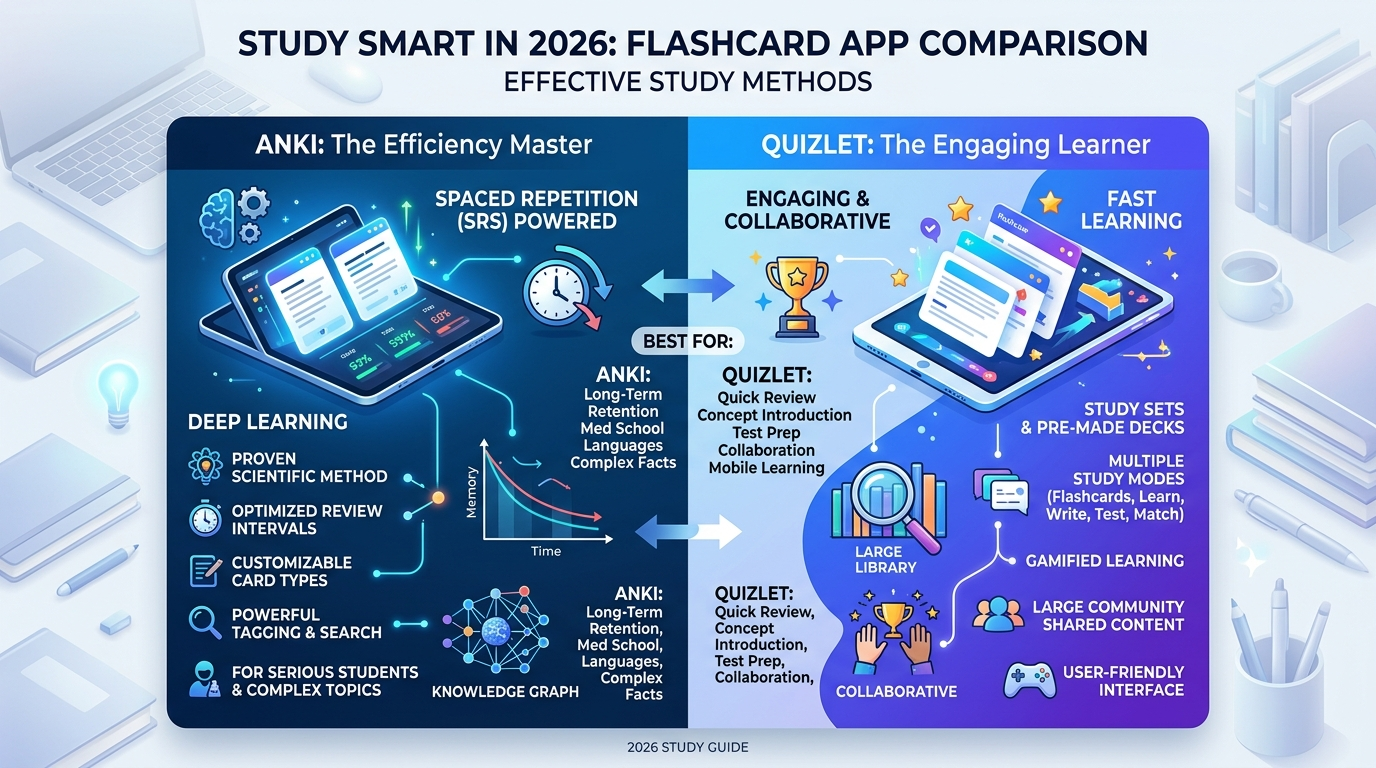
What Makes Studying Effective?
Effective studying relies on two proven methods. One is active recall. You test yourself instead of just rereading. The other is spaced repetition. You review material just before you forget it.
Research supports these methods. A 2026 meta-analysis in The Clinical Teacher looked at over 21,000 medical learners. Spaced repetition improved test scores with a clear positive effect. Other studies link regular Anki use to higher exam scores, such as on the USMLE Step 1. Consequently, tools that schedule reviews well tend to produce better long-term results.
Anki in 2026: Built for Long-Term Memory
Anki focuses on serious memorization. It uses advanced spaced repetition. The original algorithm is based on SM-2. In recent versions, users can also choose FSRS. This newer option often requires fewer reviews for the same retention.
Moreover, Anki is free on desktop and Android. The iOS app costs a one-time fee of about $25. There are no subscriptions. In addition, offline access works fully. You can customize cards heavily with cloze deletions, images, audio, and add-ons.
However, Anki has a steep learning curve. It takes days or weeks to master. Pre-made decks exist on AnkiWeb, especially strong ones for medicine. Yet creating your own cards takes time.
As a result, Anki shines for medical students, language learners, and anyone facing years of material. For example, thousands of facts across anatomy or vocabulary stick better with its scheduling.
Quizlet in 2026: Easy and Quick to Start
Quizlet prioritizes ease and speed. You can open it and study in minutes. It offers a massive library of user-created sets. Many classmates already share decks there.
Furthermore, Quizlet includes games, Match mode, and Test mode. These keep sessions engaging. In 2026, Quizlet added stronger features. It now has a spaced repetition system that schedules reviews more intelligently. AI tools help generate cards from notes or PDFs. Audio tools turn lectures into study material. Podcast-style reviews let you study on the go.
On the other hand, the free version has limits and ads. Full features, including unlimited Learn mode and offline access, require Quizlet Plus. This costs around $36 per year.
Therefore, Quizlet works best for short-term goals. It suits high school classes, weekly quizzes, or collaborative group study. For instance, if your test is next week, you can find a ready set and begin right away.
Side-by-Side Comparison Tables
Here is a clear feature comparison for 2026:
| Feature | Anki | Quizlet |
|---|---|---|
| Spaced Repetition | Advanced (SM-2 / FSRS) | Improved but basic |
| Ease of Use | Steep learning curve | Very beginner-friendly |
| Pre-made Content | Good community decks | Massive library |
| Customization | Extremely high | Limited |
| AI Features | Via add-ons only | Built-in (mostly paid) |
| Offline Access | Full and free | Mostly paid |
| Mobile Experience | Strong on Android; paid on iOS | Strong on both platforms |
| Best For | Long-term retention | Quick review and collaboration |
Next, consider pricing:
| Aspect | Anki | Quizlet |
|---|---|---|
| Desktop / Web | Free | Free with limits |
| Android | Free | Free with limits |
| iOS | One-time ~$25 | Free + paid upgrades |
| Premium Cost | None | ~$36 per year |
| Long-Term Value | Excellent | Higher ongoing cost |
These tables show the trade-offs clearly. Anki wins on retention power and cost over years. Meanwhile, Quizlet wins on speed and social features.
For a broader look at both platforms, read our Anki vs Quizlet comparison.
When to Choose Anki
Choose Anki if you need lasting knowledge. For example, medical, dental, or law students face huge volumes of facts. Language learners building fluency over years also benefit. In addition, anyone with 500 or more cards over months should prefer Anki.
The science backs this. Spaced repetition schedules reviews optimally. Cards you struggle with appear more often. As a result, memory strengthens efficiently. Studies link consistent Anki use to better exam performance in medical settings.
However, you must invest time upfront. Once set up, daily reviews stay manageable.
When to Choose Quizlet
Choose Quizlet if speed matters most. For instance, when an exam is days away, pre-made sets save hours. Collaborative classes also favor Quizlet. Friends can share sets easily. Games reduce study fatigue.
Moreover, the 2026 updates improved its adaptive tools. The new spaced repetition helps more than older versions. AI generation speeds up card creation from your notes. Consequently, beginners and casual learners start faster and stay motivated.
Yet for multi-year retention, it falls short of Anki’s algorithm.
Can You Use Both?
Yes. Many students do this. They use Quizlet for class sets and quick reviews. Then they move important cards to Anki for long-term practice. Export options make this possible. Therefore, you gain the strengths of each tool.
New users can learn the basics in our complete guide for Anki and Quizlet.
Final Verdict for 2026
Anki is better for effective long-term studying. Its advanced spaced repetition and free core features deliver superior retention. Research in medical education supports this approach. On the other hand, Quizlet is better for ease, speed, and short-term needs.
In short, pick Anki if retention over months or years is the goal. Pick Quizlet if you need simple tools right now. Either way, consistent use of active recall matters most. Start with the tool that matches your timeline and stick with it. Your memory will improve as a result.