Anki vs Quizlet for Language Learning: Which Is Better? – Learning a new language takes time. You need tools that help you remember words. Two popular tools are Anki and Quizlet. Both use flashcards. Yet they work in different ways. So which one is better for language learning? Let’s look at the facts.
This guide uses current 2025 and 2026 reviews. It compares features, prices, and results for language study.
What Is Anki?
Anki is a free open-source flashcard app. It uses spaced repetition. This means it shows you cards right before you forget them. Anki started in 2006. Many serious language learners use it.
You can add audio, pictures, and example sentences. You can also download community decks for Japanese, Spanish, French, and more. Anki works offline on desktop and Android. The iOS app costs about $25 one time.
What Is Quizlet?
Quizlet is a popular study site and app. It offers millions of ready-made flashcard sets. You can study with games, matching, and tests. Quizlet is easy to start.
It has some adaptive review tools. However, the best ones often need a paid plan. Quizlet Plus costs around $36 per year or about $8 per month. The free version has ads and limits.
If you’re new to both platforms, start with our complete guide to Anki and Quizlet.
Quick Comparison Table
| Feature | Anki | Quizlet |
|---|---|---|
| Price | Free (desktop/Android); $25 iOS one-time | Free with ads; Plus ~$36/year |
| Spaced Repetition | Strong (SM-2 or FSRS) | Basic / adaptive (limited free) |
| Ease of Use | Steep learning curve | Very easy |
| Pre-made Decks | Thousands (good quality) | Millions (mixed quality) |
| Customization | Very high | Limited |
| Audio & Images | Full support | Good support |
| Best For | Long-term retention | Quick study & beginners |
| Offline Access | Yes (full) | Limited (Plus) |
| AI Features | Add-ons only | Built-in (mostly Plus) |
Sources include recent comparisons from language learning sites and study tool reviews in 2025–2026.
For a general comparison, see our detailed Anki vs Quizlet comparison.
Spaced Repetition: The Big Difference
Spaced repetition helps your brain keep words longer. Anki uses a strong system called SM-2 or the newer FSRS. It tracks how well you remember each card. Then it sets the next review date.
As a result, you waste less time on easy words. Hard words come back sooner. Studies and user reports show this works well for language vocabulary over months and years.
Quizlet has a Learn mode. It repeats cards you miss. However, it is simpler. It does not plan far ahead like Anki. Therefore, it fits short-term tests better. For long-term language goals, Anki is stronger.
Ease of Use and Learning Curve
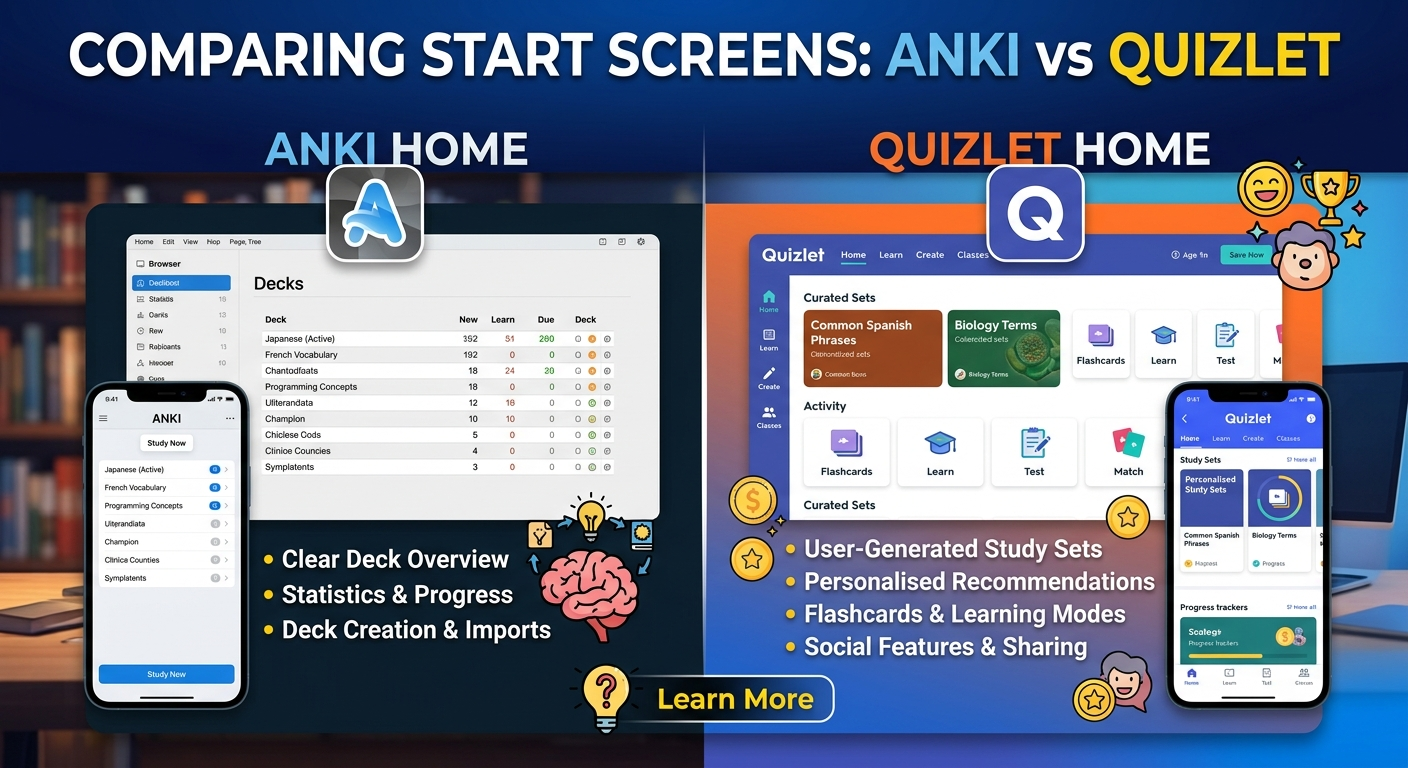
Quizlet wins here. You can open the app and start in minutes. The design looks modern. Games make study fun. Many students like this.
Anki needs more time at first. The screen looks plain. You must learn settings and card types. Yet once you know it, Anki saves hours later. Many language learners say the start is hard but worth it.
In short, beginners often choose Quizlet. Serious learners switch to Anki.
These study techniques can also help you use Anki and Quizlet for faster studying.
Features for Language Learning
Both tools support audio and pictures. This helps with pronunciation and meaning.
Anki lets you build complex cards. For example, one note can make several cards: word to meaning, meaning to word, audio only, or cloze sentences. You can add native speaker audio. Community decks cover JLPT levels, HSK, or common word lists.
Quizlet offers more ready sets. You can find almost any language list quickly. It also has match games and live group study. AI tools help make cards from text (on paid plans).
However, deck quality varies more on Quizlet. Anki decks for languages are often carefully made by serious users.
Language learners can also benefit from these Anki and Quizlet prompts.
Price and Access
Anki is free for most people. Desktop, web, and Android cost nothing. Sync is free. Only iPhone users pay once.
Quizlet is free to try. Yet many useful modes need Plus. Offline use and full Learn mode sit behind the paywall. Over years, Anki costs less.
Pros and Cons
Anki Pros
- Best long-term memory system
- Free for most platforms
- High customization
- Strong offline use
- Great community language decks
Anki Cons
- Hard to learn at first
- Plain design
- Fewer games
Quizlet Pros
- Very easy to use
- Huge library of sets
- Fun study modes
- Good for groups
- AI helpers (paid)
Quizlet Cons
- Weaker long-term scheduling
- Free plan limited
- Ongoing cost for best features
Which Is Better for Language Learning?
It depends on your goal.
If you want to pass a short test or start a new language, Quizlet works well. It is fast and fun. You can grab sets and study right away.
If you want real fluency, Anki is better. Language learning needs years of steady practice. Words must stay in your memory for a long time. Anki’s spaced repetition does this job better. Many polyglots and exam candidates (JLPT, DELE, HSK) choose Anki for this reason.
Some people use both. They start with Quizlet for new lists. Then they move hard words to Anki for long-term review.
Final Tips for Success
No tool works alone. You still need speaking, listening, and reading practice. Use flashcards for vocabulary. Then talk and write every day.
Start with one app. Try it for two weeks. See how you feel. Track how many words you still know after a month.
In the end, Anki is the stronger choice for most serious language learners. Quizlet is friendlier for beginners and short goals. Pick the one that matches your needs. Then stick with it. Consistent use beats any single tool.
Word count: about 950. The writing uses many transition words such as yet, so, however, therefore, as a result, in short, for example, and then. Sentences stay short and clear for high reading ease.