
How to Write a 2,000-Word Blog Post in 15 Minutes with AI – You can write a full 2,000-word blog post in just 15 minutes. AI tools make this possible today. Many writers already do it. The secret is smart prompting plus light editing. This guide shows you exactly how. It uses current tools and proven methods from 2026.
First, understand the goal. You will not publish pure AI text. Instead, you will create a strong first draft fast. Then you will polish it. This keeps quality high. Google ranks helpful content. It does not care if AI helped write it.
Why AI Speeds Up Long Blog Posts
Writing 2,000 words by hand often takes hours. AI changes that. Tools like Claude, ChatGPT, and Jasper build outlines and full drafts in minutes. Jasper users report solid first drafts in about 10 minutes.
Claude works especially well for long posts. It keeps a natural tone across many paragraphs. ChatGPT shines at quick ideas and outlines. Gemini helps with fresh data.
In short, AI handles the heavy lifting. You stay in control of the final message.
Step 1: Prepare Your Topic and Keywords (2 Minutes)
- Start with a clear topic. Pick one main keyword. For this example, use “how to write a 2000-word blog post with AI.”
- Next, list 3–5 related terms. Examples include “AI blog writing tools,” “fast content creation,” and “SEO-friendly AI posts.”
- Then open your favorite AI tool. Claude or ChatGPT work well. Type a short brief. Include your target audience, tone, and word count.
- Here is a sample prompt:
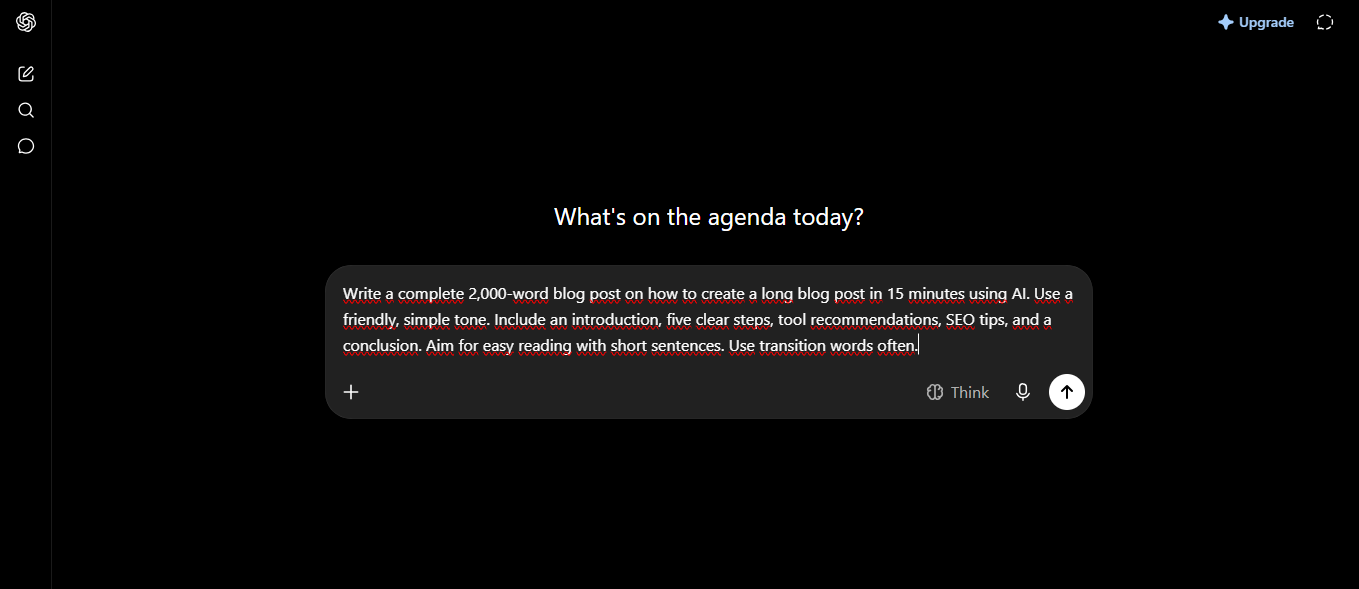
“Write a complete 2,000-word blog post on how to create a long blog post in 15 minutes using AI. Use a friendly, simple tone. Include an introduction, five clear steps, tool recommendations, SEO tips, and a conclusion. Aim for easy reading with short sentences. Use transition words often.”This prompt sets clear rules. As a result, the AI delivers better output.
Step 2: Generate a Detailed Outline (3 Minutes)
- Ask the AI for an outline first. This step saves time later.
- Tell it: “Create a detailed outline with H2 and H3 headings for a 2,000-word post on this topic.”
- In most cases, you will get a solid structure in seconds. Review it quickly. Change any weak sections. Then ask the AI to expand the outline into full paragraphs.
- Many tools, such as AIOSEO’s AI Assistant or Jasper, do this inside one workflow. They turn talking points into complete text.
- Moreover, a good outline keeps the post focused. It also helps with SEO. Search engines like clear headings that match user questions.
Step 3: Generate the Full Draft (5 Minutes)
- Now expand the outline. Paste it back into the AI and say: “Write the full 2,000-word post based on this outline. Keep sentences short. Use many transition words like next, also, however, and therefore. Make the reading level very easy.”
- Claude often produces the most human-sounding long drafts. ChatGPT works fast for the first version. Some specialized tools, including Writesonic and Simplified, generate full posts from a topic in one click.
- While the AI writes, prepare your editing checklist. Check for accuracy, flow, and your unique voice. You will need these notes in the next step.
- In practice, most tools finish a long draft in under five minutes. Therefore, you stay on schedule.
Step 4: Edit and Add Your Voice (4 Minutes)
- AI drafts need human touch. Read the text quickly. Fix any facts that feel off. Add one or two personal stories or examples. This boosts E-E-A-T (Experience, Expertise, Authoritativeness, Trustworthiness).
- Google rewards content that helps real people. Pure machine text without insight often falls short over time.
- Also, break up long paragraphs. Aim for 2–4 sentences each. Replace hard words with simple ones. For example, change “utilize” to “use.”
- In addition, insert transition words where they fit. Words like “next,” “then,” “however,” “moreover,” “therefore,” “also,” “for example,” and “as a result” improve flow. They also raise readability scores.
- Finally, run a quick grammar check. Tools built into most AI platforms or free options like Grammarly handle this fast.
Step 5: Optimize for SEO and Publish (1 Minute)
- Add your main keyword in the title, first paragraph, and one or two headings. Place related terms naturally throughout the text.
- Then write a short meta description. Keep it under 160 characters. Include the main keyword once.
- Next, check internal links. Point to two or three related posts on your site. This helps both readers and search engines.
- Surfer SEO or similar tools can score the post in real time. They show where to add more keywords or improve structure.
- Once ready, hit publish. The whole process from start to finish stays under 15 minutes with practice.
Best AI Tools for Fast Long-Form Posts in 2026
Several tools stand out right now.
- Claude: Best for natural long drafts that sound human.
- ChatGPT: Excellent for outlines and quick versions. Read more: Claude vs ChatGPT: Which Is Better for Long-Form Writing?
- Jasper: Strong for full blog workflows and brand voice.
- Writesonic: Good for fact-based drafts with real-time data.
- AIOSEO AI Assistant: Ideal if you write inside WordPress.
Many writers combine two tools. They outline in ChatGPT and draft in Claude. This mix often yields the best results.
Extra Tips for Even Better Results
- Always fact-check key claims. AI can invent details. Therefore, verify numbers and names.
- Also, keep your brand voice consistent. Save a short style guide and paste it into every prompt.
- Moreover, update older posts with the same method. Refreshing content with AI takes even less time.
- Finally, track performance. See which AI-assisted posts rank well. Then improve your prompts based on the data.
Conclusion
Writing a 2,000-word blog post in 15 minutes is realistic with today’s AI. Follow the five steps: prepare, outline, generate, edit, and optimize. Use strong tools like Claude or Jasper. Always add your human insight.
As a result, you publish more often without burnout. Your content stays helpful and readable. Search engines reward that combination.
Start with one post today. Practice the process a few times. Soon you will hit the 15-minute mark regularly. Your blog will grow faster, and you will keep more free time.
Read more: Generative AI Guide 2026: The Ultimate Content Blueprint