YouTube Script AI Prompts for Highest Audience Retention in 2026 – Audience retention decides which YouTube videos grow and which ones fade. In 2026, the average retention rate across long-form videos sits roughly between 35% and 45%. Videos that hold viewers longer earn more recommendations from the algorithm. Creators who master retention therefore gain a clear edge.
Fortunately, AI tools make high-retention scripting faster and more reliable than ever. With the right prompts, you can generate hooks that stop the scroll, structures that sustain attention, and loops that keep people watching until the end. This guide shares proven AI prompts and strategies tailored for maximum audience retention in 2026.
Why Audience Retention Matters More Than Ever in 2026
YouTube rewards watch time heavily. Higher average percentage viewed (APV) signals quality to the algorithm. As a result, videos with strong retention get pushed to more viewers. Data from 2025–2026 shows that many videos lose over half their audience in the first minute. The first 15–30 seconds remain the most critical window.
Good targets depend on length. For videos under 10 minutes, aim for 40–50% or higher. Longer videos often succeed at 35–45%. Top performers regularly clear 50–60% or more. Shorts follow different rules, with higher percentage targets, but the principles of tight scripting still apply.
Weak scripts cause most drop-offs. Generic openings, slow pacing, and missing curiosity gaps send viewers away. Strong scripts, by contrast, front-load value, create open loops, and vary energy. AI shines here because it can apply these principles consistently once you give it clear instructions.
Core Elements of High-Retention YouTube Scripts
Before diving into prompts, understand what works. High-retention scripts usually follow a clear flow.
Start with a powerful hook in the first 5–15 seconds. Avoid “Hey guys, welcome back.” Instead, use a bold claim, surprising result, pattern interrupt, or direct question. Pattern interrupts in the first five seconds can improve retention by around 23% on average.
Next, deliver context and a clear promise. Tell viewers exactly what they will gain and why they should stay. Then move into the body with storytelling, proof, and short sections. Insert retention loops every 45–60 seconds—teases that reference upcoming value without being vague.
Finally, close with a tight summary and a single strong call-to-action. Keep the CTA short so it does not cut into watch time.
Transition words, short sentences, and conversational language also help. Viewers process spoken words differently from written text. Therefore, scripts that sound natural perform better.
Read more : AI Video Generators Guide for Faceless YouTube in 2026
Ready-to-Use AI Prompts for Maximum Retention
Copy these prompts into ChatGPT, Claude, Gemini, DeepSeek, or similar tools. Replace the brackets with your details. Always edit the output for your voice and verify facts.
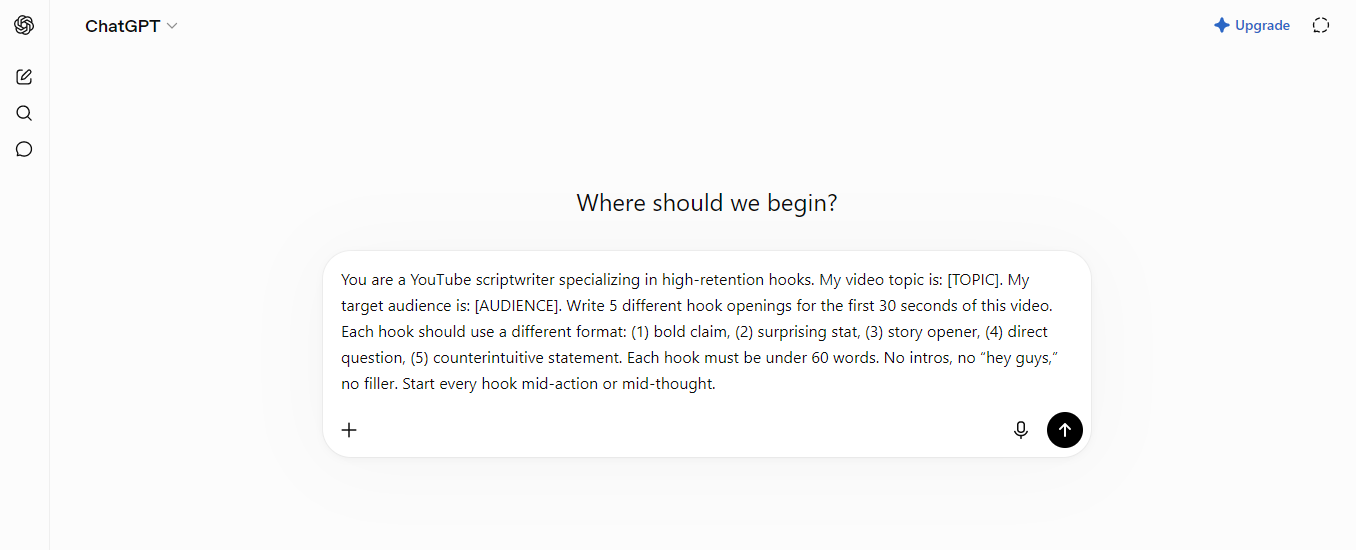
Prompt 1: Viral Hook Generator
You are a YouTube scriptwriter specializing in high-retention hooks. My video topic is: [TOPIC]. My target audience is: [AUDIENCE]. Write 5 different hook openings for the first 30 seconds of this video. Each hook should use a different format: (1) bold claim, (2) surprising stat, (3) story opener, (4) direct question, (5) counterintuitive statement. Each hook must be under 60 words. No intros, no “hey guys,” no filler. Start every hook mid-action or mid-thought.
This prompt produces options you can test. Strong hooks create an immediate information gap that pulls viewers forward.
Prompt 2: Full High-Retention Script Outline
You are a master YouTube script writer focused on audience retention. Create a complete skeleton structure for a video titled [TITLE]. Target length: [MINUTES] minutes. Audience: [AUDIENCE]. Goal: highest possible retention. Structure it as: Hook (0–15 seconds), Intro with open loop (15–45 seconds), Body with 3–5 clear sections, retention loops every 60 seconds, Climax or key payoff, Summary, and short CTA. For each section include: what to cover, what the viewer expects, and how to present it for flow and curiosity. Be descriptive.
Use the outline as a roadmap. Then expand each section one by one for tighter control.
Prompt 3: Complete Retention-Optimized Script
You are a Professional YouTube Script Writer with expertise in high-retention content and viewer psychology. Write a full script for the video titled [TITLE]. Length: approximately [WORD COUNT or MINUTES]. Follow this formula: Hook (3–15 seconds) > Intro with clear value and open loop > Body using storytelling > Problem or challenge > Exploration and development > Climax/key moment > Conclusion/Summary > Call to Action (under 10 seconds).
Key rules:
- Never start with “welcome” or channel intro.
- Use open loops and information gaps throughout.
- Be conversational, empathetic, and occasionally humorous.
- Use simple words a 12-year-old can understand.
- Include natural engagement prompts and visual cues.
- Avoid generic AI phrases.
Output only the spoken script with clear section headings.
This style of detailed instruction consistently produces stronger results than vague requests.
Prompt 4: Retention Loop Inserter
You are a YouTube retention specialist. Here is my current script draft: [PASTE SCRIPT]. Identify natural break points every 45–60 seconds. At each point insert a short retention loop (1–2 sentences) that teases specific upcoming value. Make the loops sound natural, create mild suspense, and avoid clickbait. Return the full script with [RETENTION LOOP] labels.
Adding these loops prevents mid-video drop-offs and raises overall average view duration.
Prompt 5: Problem-Agitation Opener
Write a 100–150 word problem-agitation paragraph for a YouTube script. The viewer’s problem is: [PROBLEM]. Audience: [AUDIENCE]. Tone: conversational and direct. Name the problem in the first sentence, describe the daily pain, raise the stakes of inaction, and end with a pivot to the solution. Write as spoken words.
This technique makes the content personal and increases emotional investment early.
How to Use These Prompts Effectively in 2026
First, fill in specific details. Vague inputs produce generic output. Second, generate multiple versions of hooks and test them against your analytics. Third, always read the script aloud and trim filler. Fourth, add your personal stories, unique insights, and channel personality. AI provides structure; you supply authenticity.
In addition, match the tone to your niche. Educational channels benefit from clear steps and proof. Entertainment channels need more energy shifts and humor. Furthermore, include visual cues in the prompt so the AI suggests B-roll or on-screen text that supports pacing.
Track results after publishing. Watch the audience retention graph closely. Notice where viewers leave and refine future prompts accordingly. Over time, your prompt library becomes a powerful competitive advantage.
Extra Tips for 2026 Retention Success
Keep sentences short and spoken. Vary energy every 20–30 seconds with questions, examples, or pattern breaks. Front-load the biggest value so early drop-offs still leave a positive impression. End screens and cards work better when the final seconds still deliver value rather than pure selling.
Moreover, combine AI scripting with strong titles and thumbnails. Retention cannot save a video that fails to get the click. However, once viewers arrive, a retention-focused script maximizes their time on the platform.
Final Thoughts
High audience retention in 2026 starts with intentional scripting. AI prompts remove the guesswork and speed up the process dramatically. By using the frameworks above—strong hooks, clear structure, regular curiosity gaps, and conversational delivery—you can write scripts that hold attention longer and perform better in the algorithm.
Start with the hook generator today. Test one new prompt on your next video. Then measure the retention graph. Small improvements compound quickly. Creators who treat scripting as a skill rather than an afterthought will continue to win more views, longer sessions, and stronger channel growth.