
Anki vs Quizlet for Exams: Which Flashcard Tool Wins Today? – Students face a big choice today. They need the right flashcard tool for exams. Anki and Quizlet stand out as the top options. Both help you memorize facts. Yet they work in very different ways.
This guide compares them with current details from 2026. It uses clear facts from recent reviews and student reports. You will see which tool fits your exam goals. Short sentences keep the reading easy. Transition words appear often to link ideas smoothly. If you’re unfamiliar with either platform, our Anki and Quizlet beginner guide is a good place to start.
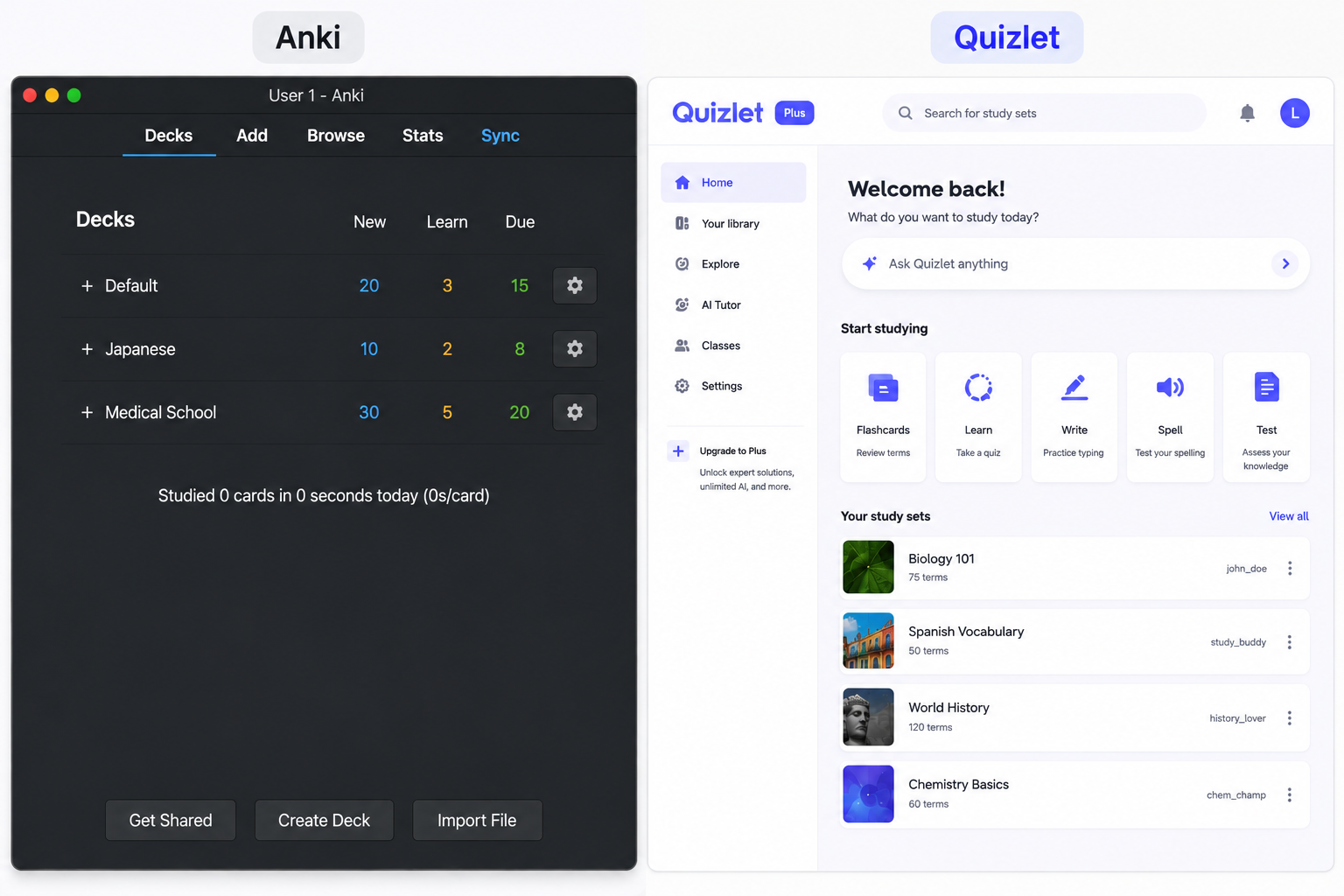
What Is Anki?
Anki is a free open-source flashcard app. It runs on desktop computers and Android phones at no cost. The official iOS app costs about $25 one time. Anki focuses on spaced repetition. This means the app shows cards right before you forget them.
Recent versions use the FSRS algorithm by default. Experts trained it on hundreds of millions of real reviews. As a result, it schedules reviews more efficiently than older systems. Many medical students rely on shared decks like AnKing. Therefore, Anki shines for long study periods.
What Is Quizlet?
Quizlet is a popular online flashcard platform. It offers a free plan with ads and limits. The Plus plan costs around $36 per year or $8 per month. Quizlet makes study simple and social. You can find millions of ready-made sets.
It includes fun modes like Match and Test. Collaboration tools let classmates share sets easily. However, its spaced repetition stays basic. The Learn mode works mainly inside one session and often needs a paid plan. Consequently, Quizlet suits short-term review better.
For the complete feature breakdown, read our Anki vs Quizlet comparison.
Side-by-Side Feature Comparison
Here is a clear table of key features based on 2026 data:
| Feature | Anki | Quizlet |
|---|---|---|
| Spaced Repetition | Advanced (FSRS / SM-2) | Basic (mainly paid Learn mode) |
| Price | Free (desktop/Android); $25 one-time iOS | Free with limits; ~$36/year Plus |
| Pre-made Decks | Strong community (especially medical) | Huge library of user sets |
| Customization | Very high (templates, add-ons, images) | Limited (mostly term-definition) |
| Offline Access | Full | Limited (often needs Plus) |
| Learning Curve | Steep | Very easy |
| Collaboration | Limited | Strong (classes, live games) |
| Best For | Long-term retention | Quick review and groups |
This table shows the main differences at a glance. In addition, Anki gives full control over card design. Quizlet focuses on speed and sharing.
Pricing Breakdown
Cost matters for students. Anki stays free for most users. You pay once only for the official iPhone app. There are no monthly fees or feature locks on desktop or Android.
Quizlet starts free. Yet many useful tools require Plus. Ads appear on the free plan. Offline study and unlimited Learn mode need payment. Over two years, Quizlet can cost more than Anki. Therefore, Anki offers better long-term value for heavy users.
Pros and Cons for Exam Prep
Anki has clear strengths. First, its algorithm supports memory over months and years. Second, it handles thousands of cards well. Third, offline use works fully. Medical and law students often choose it for board exams. Studies show Anki users score higher on some standardized tests.
However, the interface looks dated. The learning curve takes time. New users may need a few hours to set it up.
Quizlet wins on ease. You start in minutes. Ready-made sets save time. Games keep study fun. Class groups share material fast. On the other hand, long-term retention is weaker. Free limits grow tighter. The algorithm does not model forgetting curves across weeks.
As a result, Quizlet works best for tests next week. Anki works better for exams months away.
Which Tool Wins for Different Exams?
Consider your timeline. If your exam is less than two weeks away, choose Quizlet. You can grab a shared set and drill quickly. Collaboration helps study groups.
If you prepare for months or years, pick Anki. Medical students preparing for USMLE or similar boards almost always use Anki. Language learners and law students follow the same path. The spaced system reduces daily review time by 20-30 percent with FSRS while keeping high retention.
Furthermore, hybrid use is possible. Some students make quick sets on Quizlet then move important cards to Anki. Yet most serious exam prep stays with one main tool. You can also learn techniques for getting Anki and Quizlet for faster study results.
Final Verdict: Anki Wins for Most Serious Exams
Today the clear winner for high-stakes exams is Anki. Its advanced scheduling and free access deliver lasting results. Quizlet remains useful for short bursts and group work.
In summary, match the tool to your needs. Start with Anki if retention over time matters most. Choose Quizlet if speed and simplicity come first. Both tools improve with daily practice. Pick one, stay consistent, and watch your exam scores rise. For exam preparation, these Anki and Quizlet study workflows can help organize your revision.
Sources include recent 2026 comparisons from educational review sites and student reports. Always check official apps for the latest prices and features.