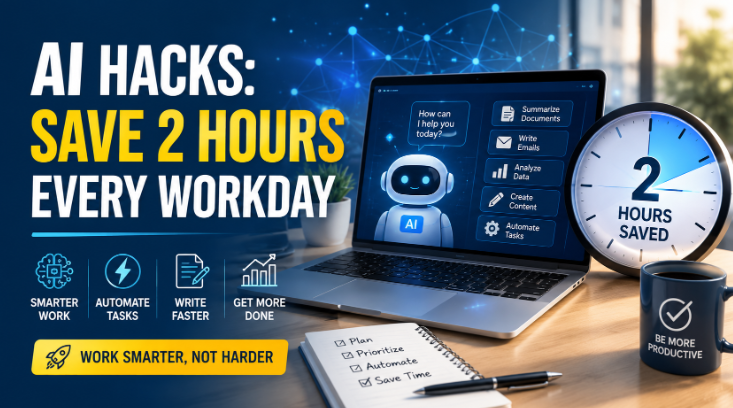
How to Save 2 Hours Every Workday With Simple AI Hacks – Imagine reclaiming two full hours every single workday. That is not a distant dream. Instead, smart AI tools make it possible right now. Many professionals already use simple AI hacks to cut routine tasks dramatically. As a result, they finish faster and focus on higher-value work. Research from McKinsey shows generative AI can automate activities that currently absorb 60 to 70 percent of employees’ time. Meanwhile, studies cited by Harvard Business Review find tools like ChatGPT and Copilot can slash task time by up to 56 percent in coding and about 40 percent in writing. Therefore, these gains add up quickly.
In this article, you will discover practical AI hacks that help you save roughly two hours daily. First, we cover email and communication. Next, we tackle meetings and research. After that, we explore content creation, data work, and daily planning. Finally, we share tips to keep the benefits real. Moreover, every suggestion relies on widely available tools such as ChatGPT, Claude, Gemini, and Microsoft Copilot. In addition, the advice stays current with 2025–2026 findings.
Start Your Day Strong with Smarter Email and Messaging
Email often eats the first hour of the day. However, AI can shrink that time sharply. Open your preferred AI tool and paste a long email thread. Then ask it to summarize the key points and suggest a clear reply. As a result, you respond in minutes instead of rereading everything. Furthermore, you can create custom instructions so the AI matches your tone every time.
For example, many people set a standing prompt: “Write short, professional replies that sound friendly yet direct.” Consequently, drafting becomes almost automatic. HBR notes that generative AI helps employees write emails and similar content far faster. Therefore, this single habit can free 20 to 30 minutes each morning. Meanwhile, tools integrated into Gmail or Outlook, such as Gemini or Copilot, work even more smoothly inside your inbox.
Next, apply the same idea to chat messages or Slack threads. Instead of scrolling endlessly, ask the AI for a quick digest and action items. In this way, you stay informed without the usual time drain.
Turn Meetings into Quick Wins
Meetings rank among the biggest time thieves. Yet AI changes that equation. First, use an AI notetaker such as those built into Zoom, Teams, or dedicated tools. After the call ends, the system delivers a clean summary, decisions, and follow-ups. Consequently, you skip the usual hour of note-cleaning and email writing.
In addition, prepare for meetings faster. Feed the agenda and past notes into Claude or ChatGPT. Then request talking points, possible questions, and a short briefing. As a result, you walk in ready without hours of prep. McKinsey research highlights how AI frees resources by streamlining such workflows. Therefore, professionals often reclaim 30 to 45 minutes per meeting-heavy day.
Moreover, after the meeting, ask the AI to draft follow-up emails or task lists. This step alone prevents the common post-meeting scramble. Over a typical workweek, these habits easily contribute half an hour or more of daily savings.
Research and Information Gathering at Lightning Speed
Deep research used to take hours. Now it takes minutes. Start by giving ChatGPT, Claude, or Gemini a clear question plus any relevant documents. Then request a structured summary with sources or key insights. In return, you receive organized information ready for decisions.
For instance, marketers pull competitor insights in one prompt. Meanwhile, analysts generate first-pass data reviews almost instantly. HBR reports that gen AI coding tools cut programming time by 56 percent in studies from MIT Sloan, Microsoft, and GitHub. Similarly, knowledge workers see parallel gains in research tasks. Therefore, what once required half a morning now fits into a short break.
Furthermore, use AI to cross-check facts or expand outlines. Ask follow-up questions to dig deeper without opening dozens of tabs. As a result, your research stays focused and efficient. Over time, this approach reliably saves 30 to 40 minutes daily for most knowledge workers.
Create Content and Documents Without the Blank-Page Struggle
Writing reports, presentations, or social posts no longer starts from zero. Instead, feed the AI your rough notes or goals. Then request a first draft, outline, or full slides. Claude, for example, can now generate editable PowerPoint files and Word documents from simple prompts. Consequently, formatting and structure appear almost instantly.
In addition, refine the output quickly. Tell the AI to adjust tone, shorten sections, or add data points. Meanwhile, Gemini works especially well inside Google Workspace for collaborative documents. As a result, the entire creation cycle shrinks dramatically. Many users report finishing drafts in a fraction of the previous time.
Moreover, apply the same method to internal documents, proposals, or even code snippets. McKinsey findings show developers complete certain coding tasks up to twice as fast with generative AI. Therefore, technical and non-technical roles both benefit. This category alone often delivers another 30 minutes of daily savings when used consistently.
Handle Data, Spreadsheets, and Routine Analysis
Numbers and spreadsheets slow many people down. However, AI tools simplify them. Paste a data table into ChatGPT or Claude and request summaries, trends, or simple charts. In return, you get insights without building pivot tables from scratch. Furthermore, Excel Copilot or Google Sheets AI features perform similar magic inside the spreadsheet itself.
For example, ask the tool to clean messy data, highlight anomalies, or draft explanations for stakeholders. As a result, routine analysis that once took an hour can finish in fifteen minutes. In addition, you can generate formulas or Python snippets for more complex needs. Consequently, data-related work becomes far less painful.
These gains compound. When you combine faster analysis with quicker reporting, the daily time savings grow steadily toward the two-hour mark.
Plan Your Day and Automate Small Tasks
Even small administrative chores add up. Therefore, let AI handle scheduling outlines, to-do prioritization, and status updates. Each morning, list your open tasks and ask the AI to rank them by impact and urgency. Then request a realistic daily plan. In this way, you avoid decision fatigue and start focused.
Moreover, create reusable AI assistants or custom GPTs for recurring work. Store your preferred style, project details, and standard prompts once. Afterward, you simply call the assistant instead of rewriting instructions. HBR explains that these custom setups prevent the efficiency loss that comes from repeating background information. As a result, every interaction stays fast.
Finally, use AI for quick personal productivity boosts. Generate meeting agendas, polish performance notes, or draft training outlines. Each small win protects your schedule and keeps the total savings near two hours.
Make the Savings Stick: Practical Tips
Saving time is only the first step. Next, protect those hours. Studies show that many workers fill the extra time with more tasks rather than shorter days. Therefore, decide in advance how you will use the reclaimed time. For example, block deep-work slots, take real breaks, or learn a new skill.
In addition, always review AI output. The tools speed work, yet human judgment remains essential. Furthermore, start with one or two hacks rather than trying everything at once. As a result, the habits stick and the benefits compound.
McKinsey notes that AI productivity gains become table stakes. Organizations that help employees master these tools see stronger results. Meanwhile, individuals who treat AI as a daily partner consistently report clearer focus and less end-of-day exhaustion.
Putting It All Together
When you combine email shortcuts, smarter meetings, rapid research, faster content, easier data work, and better planning, two hours of daily savings become realistic. Research from trusted sources such as McKinsey and Harvard Business Review confirms the underlying potential. Tools improve constantly, yet the core hacks stay simple and accessible.
Start tomorrow with just one change. Summarize your inbox with AI. Or generate a meeting brief in advance. Then build from there. Before long, you will notice the difference. Two hours return to your day—time you can invest in meaningful work, creative thinking, or simply finishing on time.
The opportunity is here. Use these AI hacks wisely, and every workday becomes more productive and less draining.